Key events
Show key events only
Please turn on JavaScript to use this feature
Tehran has marked the end of Ramadan and the Persian New Year, Nowruz, as the war entered its fourth week.
Iran’s supreme leader traditionally leads Eid al-Fitr prayers, but Mojtaba Khamenei, who came to power earlier this month after his father Ali Khamenei was killed, has remained out of the public eye, reports AFP.
Instead, the head of the judiciary, Gholam Hossein Mohseni Ejei, attended prayers at central Tehran’s overflowing Imam Khomeini grand mosque.
“The atmosphere of the New Year was spreading through the city,” said Farid, an advertising executive reached by AFP through an online message.
But he added: “The thought that some people could be dying right at the New Year dinner table was painful.”
Share
Blasts heard in central Israel following warnings of incoming Iranian missiles
Several blasts could be heard from Jerusalem on Sunday, AFP journalists said, after the Israeli military warned of incoming missile fire from Iran towards central Israel.
Israel’s Magen David Adom emergency medical service said there were no immediate reports of casualties.
Share
Drone strikes target military base near Baghdad airport, reports Iranian state media
A drone attack targeted a military base near Baghdad International Airport on Sunday, according to Iran’s official IRNA news agency.
The “military base, located near Baghdad International Airport, has again been the target of drone strikes,” IRNA wrote, referring to a compound that was used in the past by the US military.
Share
Six oil ships bound for Australia have been cancelled
Sarah Basford Canales
Six oil ships bound for Australia have been cancelled in recent days but the federal government is not yet considering any drastic measures, the energy minister, Chris Bowen, says.
Bowen said on Sunday that six ships from Malaysia, Singapore and South Korea, that had been expected to arrive next month, were cancelled or deferred. The federal government was working to replace the ships, with some already substituted, the minister told ABC TV.
Australia receives about 80 shipments of oil each month, on average, predominantly from Asia. On Friday, Reuters reported record amounts of US fuel were being exported to Australia amid supply chain disruptions.
“The flow of oil to Asian refineries has slowed, and that has downward impacts on us,” Bowen said.
“We’re in an uncertain environment, so that’s why we’re doing … all the preparatory work.
“People think ‘Well, all the ships are coming now, and one day they’ll all stop in one go’. [But] that is highly unlikely to be the case. It’s much more likely that there’ll be bumps in supply, but that governments will work with the refiners and the importers to manage those and minimise impacts.”
Bowen said fuel supplies within Australia were slightly higher than before the crisis began, with 38 days of petrol. There was 30 days supply of diesel and jet fuel.
The weeks ahead could be more challenging with disruptions expected to occur for shipments arriving in late April and May, the minister conceded.
Share
Updated at 01.44 EDT
Sri Lanka raised fuel prices by 25%, the second increase in two weeks
Sri Lanka raised fuel prices by 25% on Sunday, as the economic shockwaves triggered by the war continue to ripple across the world.
Regular petrol was increased to 398 rupees ($1.30) per litre, up from 317 rupees, while diesel, the fuel commonly used for public transport, rose by 79 rupees to 382, according to a report by AFP. This is the second increase in two weeks.
“We hope to achieve a 15 to 20% reduction in fuel consumption with the latest increase,” an official at the Ceylon Petroleum Corporation said.
He said President Anura Kumara Dissanayake told them last week that the country must prepare for a prolonged conflict in the Middle East that could affect the island’s energy supplies.
Sri Lanka’s president ordered a four-day working week from last Wednesday and asked employers to reintroduce work-from-home arrangements where possible.
Share
Updated at 01.17 EDT
Agence France-Presse has spoken to residents in Arad, the southern Israeli town that was hit by an Iranian missile on Saturday night.
Ido Franky, 17, recalled hearing “terrifying” blasts like nothing he had experienced before:
double quotation markFranky rushed to shelter with his family as air raid sirens sounded, warning of an incoming attack. “There was a ‘boom, boom!’, my mother was screaming,” he said near the impact site, where an AFP correspondent saw three damaged buildings and firefighters reported a blaze.
“This was terrifying... this town had never seen anything like this,” the teenager told AFP.
Israel’s Magen David Adom emergency medical service said 84 wounded people were taken to hospitals from the Arad scene, including 10 in serious condition.
In the early hours of Sunday, dozens of people were still at the site, taking photos or calling friends and family to share details of the destruction, even as police warned residents on loudspeakers not to approach.
Security forces patrolled the streets with flashlights while rescuers searched the rubble to ensure all casualties had been recovered.
A crater around of around five metres (16 feet) was left amid the bombed-out buildings.
Police spokesman Dean Elsdunne told AFP that “the operation will take a few hours” before authorities can clear the scene and ensure all residents are accounted for.
Share
Updated at 01.07 EDT
Trump's strait of Hormuz ultimatum
Here’s a recap of Trump’s remarks on Saturday night, in which he threatened to strike Iranian power plants if Tehran does not “fully open” the strait of Hormuz within 48 hours.
Writing on Truth Social, Trump said:
double quotation markIf Iran doesn’t FULLY OPEN, WITHOUT THREAT, the Strait of Hormuz, within 48 HOURS from this exact point in time, the United States of America will hit and obliterate their various POWER PLANTS, STARTING WITH THE BIGGEST ONE FIRST!”
Iran has effectively closed down the strait by attacking ships and reportedly laying mines in the waterway, causing a major crisis in global energy markets that is now entering its fourth week.
The strait is one of the world’s most important trade routes, through which a fifth of global oil and seaborne gas is shipped.
Several Nato members and other US allies pledged last week to join “appropriate efforts to ensure safe passage” through the strait, though they have no given details of how they would do this. Trump earlier called alliance members “cowards” for not stepping in to help guard the strait.
Trump’s latest ultimatum – which marks a change in tone from remarks on Friday about “winding down” the war – has elicited warnings from Iran’s military.
The Iranian military’s operational command Khatam Al-Anbiya said in a statement carried by Fars news agency:
double quotation markFollowing previous warnings, if Iran’s fuel and energy infrastructure is violated by the enemy, all energy, information technology and desalination infrastructure belonging to the US and the regime in the region will be targeted.
Share
Updated at 00.55 EDT
Japan open to mine sweeping strait of Hormuz
Japan could consider deploying its military for minesweeping in the strait of Hormuz if a ceasefire is reached in the US-Israeli war on Iran, the foreign minister, Toshimitsu Motegi, said on Sunday, according to a Reuters report.
“If there were to be a complete ceasefire, hypothetically speaking, then things like minesweeping could come up,” Motegi told Fuji TV. “This is purely hypothetical, but if a ceasefire were established and naval mines were creating an obstacle, then I think that would be something to consider.”
Tokyo has no immediate plans to seek arrangements to allow passage through the strait of Hormuz for stranded Japanese vessels, Motegi said, adding it was “extremely important” to create conditions that allow all ships to navigate through the strait.
Iranian foreign minister Abbas Araqchi told Japan’s Kyodo news agency on Friday that he had spoken to Motegi about potentially letting Japanese-related vessels pass through the waterway.
Japan gets around 90% of its oil shipments via the strait, which Tehran has effectively closed during the war.
Share
Updated at 00.16 EDT
The United Arab Emirates says it is responding to incoming aerial attacks from Iran
The United Arab Emirates defence ministry says it is responding to “incoming missile and drone threats from Iran”, adding that sounds heard are the result of air defence systems intercepting attacks.
A ministry spokesperson said three drones had been intercepted and destroyed in the country’s eastern region, Reuters reported.
Share
Updated at 23.32 EDT
5 hours ago
Middle East crisis live: Trump gives Iran 48-hour ultimatum to open strait of Hormuz; about 100 injured in Israel
Read original articleImpacted Markets
5 markets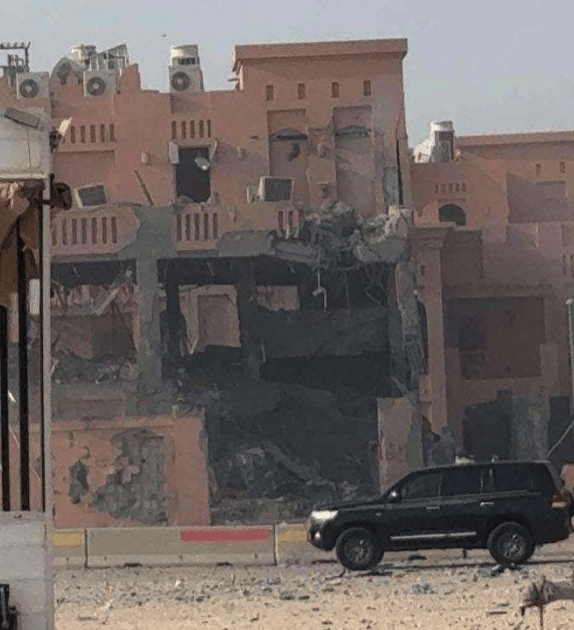
Will Israel strike 2 countries in 2026?
Polymarket
Impact
5/10
Volatility
high
Macro
medium
Risk
high
Will Israel strike 1 country in 2026?
Polymarket
Vol: $87.3k
Impact
5/10
Volatility
high
Macro
high
Risk
high
Will Israel strike 15 or more countries in 2026?
Polymarket
Liq: $10.0k
Impact
2/10
Volatility
high
Macro
high
Risk
high
Will Israel strike 12 countries in 2026?
Polymarket
Liq: $9.6k
Impact
2/10
Volatility
high
Macro
medium
Risk
high
Will Israel strike 11 countries in 2026?
Polymarket
Vol: $56.2kLiq: $9.8k
Impact
2/10
Volatility
high
Macro
high
Risk
high