Nearly 200 people were injured by Iranian strikes in the southern cities of Dimona and Arad on Saturday, 11 of them seriously, medics said, after Israeli air defenses failed to intercept at least two ballistic missiles.
Following the strikes, Prime Minister Benjamin Netanyahu and Israel Defense Forces Chief of Staff Lt. Gen. Eyal Zamir pledged to continue fighting Israel’s enemies on “all fronts,” amid the US-Israeli war with Iran that began on February 28. The IDF later said the Air Force was conducting a wave of strikes in Tehran targeting the Iranian regime’s infrastructure.
Among those seriously injured in the strikes on the south were a 12-year-old boy suffering from shrapnel injuries as a result of the strike in Dimona, and a 5-year-old girl hurt in the subsequent strike in Arad. The missile fire came amid repeated Iranian attacks on the Dimona area on Saturday.
Iranian state media said the strikes were targeting Israel’s nuclear research facility, located some 10 kilometers (six miles) outside of Dimona and 30 kilometers (18.5 miles) outside of Arad, in retaliation for an alleged US attack on Iran’s Natanz uranium enrichment facility earlier in the day. Iran blamed that attack on the US and Israel, though the IDF denied any involvement.
The Shimon Peres Negev Nuclear Research Center is believed to be key to Israel’s long-suspected nuclear weapons program, the existence of which Jerusalem neither confirms nor denies as a matter of policy.
Iran had also targeted the city of Dimona prior to the alleged attack on Natanz.
Footage posted to social media from multiple angles showed the ballistic missile hurtling out of the sky at high speed before crashing into the city. The missile carried a conventional Iranian warhead, with hundreds of kilograms of explosives, according to military assessments.
Soroka Medical Center in Beer Sheba, said it treated 175 people wounded in the attacks on Arad and Dimona, 36 of whom remained hospitalized as of Sunday morning.
In addition to the boy listed in serious condition from the Dimona strike, a woman in her 30s was moderately injured by glass shards and another 31 people were treated for light injuries in the city, the Magen David Adom emergency service said. The injuries were primarily caused by shrapnel or sustained while running for shelter. Another 14 people were treated for acute anxiety.
The ambulance service released a video of a residential building ablaze in the town.
“There was extensive damage and chaos at the scene,” MDA paramedic Carmel Cohen said in a statement.
The mother of the injured 12-year-old boy told the Kan public broadcaster that he hadn’t managed to reach the bomb shelter by the time the missile struck.
The Israel Defense Forces dispatched Home Front Command search and rescue units to the scene of the impact, amid reports that the missile, which carried a large warhead, had caused significant damage to homes and other buildings in the area.
An Iranian ballistic missile strikes the southern city of Dimona, March 21, 2026. (Social media; used in accordance with Clause 27a of the Copyright Law)
Hours later, similar scenes of destruction unfolded in nearby Arad after a ballistic missile impacted in the city, causing damage to several buildings.
MDA said its medical teams treated 84 people for physical injuries at the scene of the impact before transferring them to hospitals, including 10 who were seriously hurt — among them a 5-year-old girl.
Another 19 people were listed in moderate condition, while 55 others were lightly hurt. Another four people were treated for acute anxiety and also taken to hospitals.
Drone footage from United Hatzalah captured the impact scene in Arad.
The missile — carrying a conventional warhead with hundreds of kilograms of explosives — struck between several apartment buildings, wounding dozens of people and causing extensive damage.
Dozens of ambulances, as well as MDA helicopters and Israeli Air Force helicopters, were present at the scene to evacuate the injured to the hospital.
Police Commissioner Danny Levy, speaking at the site of the impact in Arad, said police did not believe anyone to be missing following the strike but that searches through the rubble were ongoing.
“We won’t leave here until we confirm that there is no one missing and no one we have forgotten in the rubble,” Levy said. He added that the searches were using technological means in addition to people physically searching the site of the impact.
“According to reports I received, there is no one trapped at the moment,” he said. “We are continuing to search so that we truly don’t forget anyone here.”
The military said the Israeli Air Force was investigating the failure to intercept both ballistic missiles. It confirmed air defenses had engaged both projectiles, but the interceptors failed to knock them down.
The Home Front Command was also probing the circumstances of the impacts.
But IDF spokesman Effie Defrin stressed that neither of the missiles reflected a new threat, despite the failure to shoot them down.
“The air defense systems operated but did not intercept the missile. We will investigate the incident and learn from it. This is not a special or unfamiliar type of munition,” he said in a post on X.
“Our hearts are with the residents of Arad and Dimona tonight,” Defrin added, wishing the dozens of victims a speedy recovery and stressing the importance of following Home Front Command guidelines.
Also on Saturday night, an additional Iranian missile attack set off sirens in Eilat and the surrounding area.
There were no reports of injuries, and preliminary military assessments suggested the missile heading toward Israel’s southernmost city had been intercepted.
PM: ‘Very difficult’ evening, we’ll keep fighting ‘on all fronts’
Netanyahu addressed the two strikes in a statement acknowledging the “very difficult evening in the campaign for our future.”
He said he spoke with the mayors of Dimona and Arad, and called on government ministries to “provide all necessary assistance” to the two cities.
“We will continue to strike our enemies on all fronts with determination,” the premier added.
In the hours following the strikes, the Health Ministry announced that some of those wounded in Arad and Dimona would be transferred from hospitals in the south of the country to those in the center.
Health Ministry Director General Moshe Bar Siman Tov said the health system was now operating in full emergency mode, and was preparing to provide increased mental health care for the population in the south of the country and for those who had been evacuated from their homes to hotels in the Dead Sea area.
In addition, he said the National Resilience Center had contacted the mayors of Dimona and Arad to assist with whatever was needed.
“This is a complex and difficult sequence of events, and the regulated evacuation between hospitals allows us to maintain a high level of care for each casualty, even when there are several incidents at the same time,” Siman Tov said.
Education Minister Yoav Kisch announced that all in-person educational activities would be cancelled across Israel on Sunday and Monday.
The decision, made in consultation with the Home Front Command, would be enforced across the entire country, Kisch said, including in areas that had previously been allowed to resume in-person education.
Zamir: Iran offensive has reached halfway point
In Iran on Saturday, local news agencies reported that a hospital and a tourist site in the country’s southwest were damaged in Israeli and US strikes, killing at least one child.
According to the semi-official Mehr and Fars news agencies, strikes killed a child at the Ritaj entertainment complex in Ahvaz and damaged the Andimeshk’s Imam Ali Hospital, both of which are in the Khuzestan province on the border with Iraq. The hospital said the blast created significant damage and that the hospital was no longer accepting patients, but did not give any other information.
Defense Minister Israel Katz said the strikes against Iran could be expected to intensify in the coming week.
“This week, the intensity of the strikes that the IDF and the US military will carry out against the Iranian terror regime and the infrastructure it relies on will significantly escalate,” he said during an assessment with military officials.
Katz said that Israel is “determined to continue leading the offensive against the Iranian terror regime, to decapitate its commanders and thwart its strategic capabilities, until every security threat to the State of Israel and to US interests in the region is removed.”
Meanwhile, IDF Chief of Staff Lt. Gen. Eyal Zamir said on Saturday night that the military was halfway through its campaign against Iran.
“We are halfway through, but the direction is clear. In about a week, on Passover, the holiday of freedom, we will continue to fight for our freedom and our future,” he said in a video statement.
Zamir said that the “extensive damage we have caused to the Iranian regime over the past three weeks is beginning to accumulate into a systemic-strategic, military, economic, and governmental achievement.”
“As a result, the regime of evil is weaker, and Iran is more exposed and without significant defense capabilities. The leaders of the regime, who developed capabilities with the goal of destroying us, are battered and confused,” he said.
The IDF chief also commented on Iran’s recent long-range ballistic missile attack on the UK-US Indian Ocean military base at Diego Garcia.
The failed strike was the first indication that Tehran has missiles in its stockpiles that can travel much further than previously acknowledged.
“Just yesterday, Iran launched a two-stage intercontinental ballistic missile with a range of 4,000 kilometers [2,500 miles] toward an American target on the island of Diego Garcia. These missiles were not intended to hit Israel. Their range reaches the capitals of Europe — Berlin, Paris, and Rome are all within direct threat range,” Zamir said.
Separately, Zamir held an assessment with senior officers following the strikes in Dimona and Arad.
The assessment was attended by Operations Directorate chief Maj. Gen. Itzik Cohen, Israeli Air Force chief Maj. Gen. Tomer Bar, Intelligence Directorate chief Maj. Gen. Shlomi Binder, and Home Front Command chief Maj. Gen. Shai Klapper.
The military said Zamir instructed the officers to “continue investigating the incidents and draw lessons from them.”
In addition, Zamir approved strikes that will take place tonight “across all fronts,” the IDF added.
Gulf targeted in attacks; Saudi expels Iranian diplomats
Alongside its attacks on Israel, Iran kept up its fire on Gulf states on Saturday, firing drones at the United Arab Emirates, Saudi Arabia and Kuwait.
The UAE said it was facing aerial attacks from the Islamic Republic, after Iran warned its neighbor against allowing the US to launch attacks from its territory on disputed islands near the strategic Strait of Hormuz.
“UAE air defences are currently responding to incoming missile and drone threats from Iran,” the Emirati defense ministry said in a statement explaining that “the sounds heard are the result of the Air Defense Systems intercepting missiles and drones.”
A ministry spokesperson said Sunday morning that three drones had been intercepted and destroyed in the country’s eastern region.
The Tasnim news agency reported the Iranian military’s operational command had warned the UAE that “if any further aggression originates from its territory against the Iranian islands of Abu Musa and Greater Tunb in the Persian Gulf, Iran… will subject Ras Al Khaimah in the UAE to heavy strikes.”
Authorities in the northern emirate of Ras Al Khaimah, which shares its name with the UAE’s sixth-largest city, said later on Saturday the “sounds heard across parts of the city were the result of successful air defense interception operations.”
Abu Musa and the Greater Tunb islands, which are controlled by Iran but claimed by the UAE, have long been a source of dispute between the two countries.
The islands are located in the Gulf near the entrance to the critical global shipping chokepoint, the Strait of Hormuz.
Egypt’s president Abdel-Fattah el-Sissi and Saudi Arabia’s Crown Prince Mohammed bin Salman warned Saturday that the Iranian escalation against Gulf states endangered the safety and the stability of the region.
The state-run Saudi Press Agency reported that Sissi reiterated his country’s rejection of the Iranian attacks on the Gulf states, adding that the Egyptian president expressed solidarity with the Kingdom against threats.
Saudi Arabia’s foreign ministry said on Saturday that the Iranian security attache and his assistant, along with three other staffers in the Iranian embassy in Saudi Arabia, had to leave within 24 hours. Hours earlier, Saudi Arabia downed 20 Iranian drones, according to its defense ministry.
On Sunday morning, Saudi Arabia’s Ministry of Defense said three ballistic missiles had been detected around the capital.
“One missile was intercepted, while the other two fell in an uninhabited area,” a spokesperson for the ministry posted on social media.
Also Saturday, Arab League chief Ahmed Aboul Gheit welcomed the visits of Sissi and Jordan’s King Abdullah II to multiple Gulf states over the past few days, saying that these visits “reflect full Arab solidarity.”
5 hours ago
Over 150 injured, 11 seriously, in Iranian missile strikes on southern cities of Arad, Dimona
Read original articleImpacted Markets
5 markets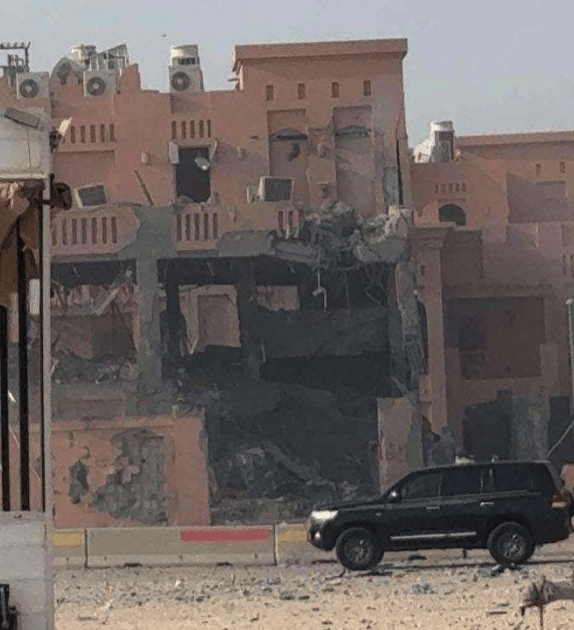
Will Israel strike 2 countries in 2026?
Polymarket
Impact
5/10
Volatility
high
Macro
high
Risk
high
Will Israel strike 11 countries in 2026?
Polymarket
Vol: $56.2kLiq: $9.8k
Impact
2/10
Volatility
medium
Macro
high
Risk
medium
Will Israel strike 15 or more countries in 2026?
Polymarket
Liq: $10.0k
Impact
3/10
Volatility
medium
Macro
medium
Risk
medium
Will Israel strike 1 country in 2026?
Polymarket
Vol: $87.3k
Impact
9/10
Volatility
high
Macro
high
Risk
high
Will Israel strike 12 countries in 2026?
Polymarket
Liq: $9.6k
Impact
5/10
Volatility
high
Macro
low
Risk
high